
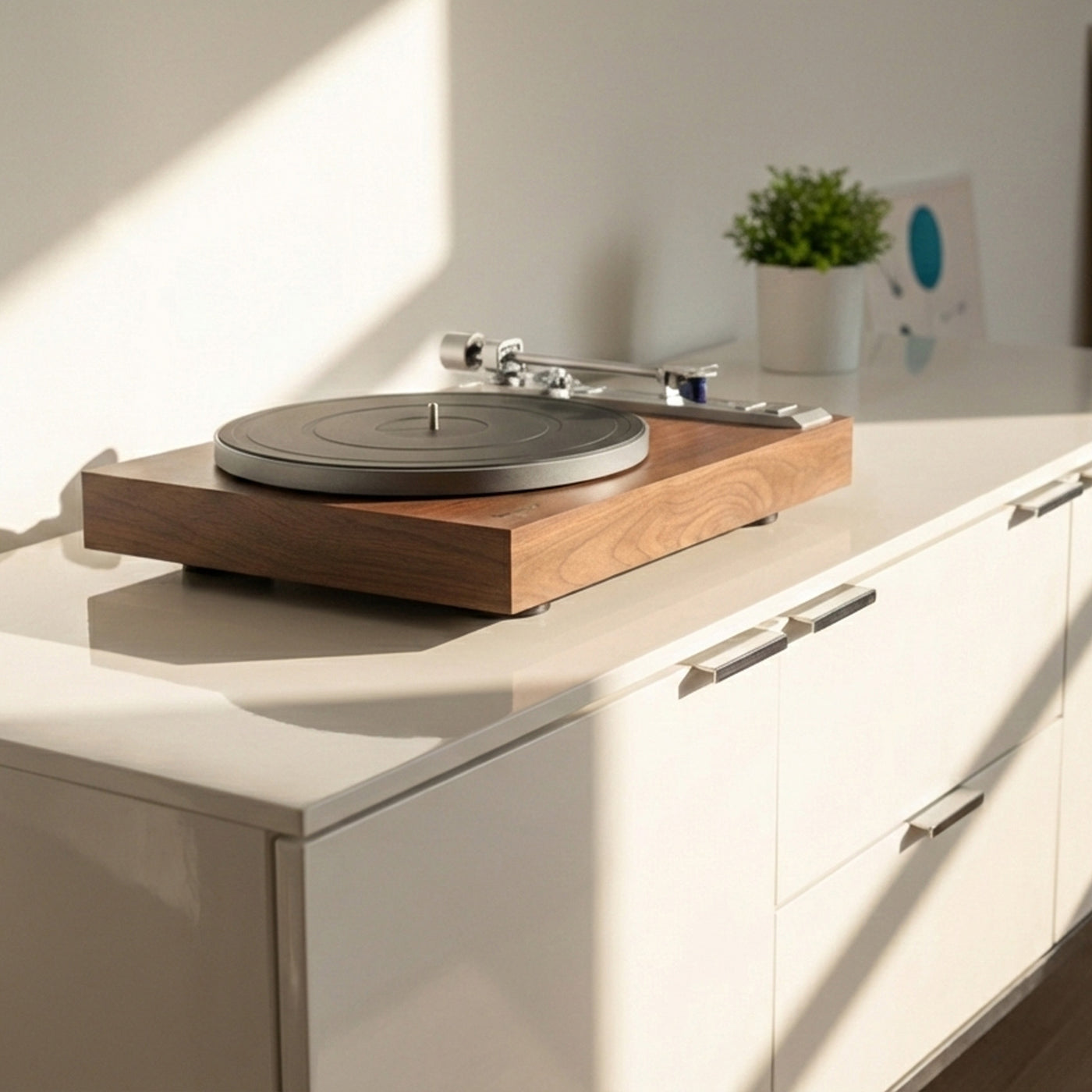
The Turntable: Back from never being gone
Vinyl is making an impressive comeback. More and more music lovers are rediscovering the charm of records. In the Netherlands, a staggering 45 million euros were spent on vinyl last year — a growth of over 21%, according to NVPI.
But it's not just about the numbers. Listening to vinyl feels different. You take a record out of the sleeve, carefully place it on the turntable, and truly take the time for music. No skip button, no endless playlists — just attention and experience.
Want to start with vinyl yourself? It all begins with the right turntable. In this guide, we’ll help you get started.
Automatic, semi-automatic, or manual
-

Fully automatic turntables
With a fully automatic turntable, you press start. The tonearm moves automatically to the record and the music begins. Is the record finished? Then the arm automatically returns to the rest position.
Ideal if you want to enjoy without hassle. -

Semi-automatic turntables (with auto-stop)
With a semi-automatic player, you manually place the tonearm on the record. At the end, the player stops automatically or the arm returns.
A nice balance between ease of use and engagement. -

Manual turntables
With a manual turntable, you do everything yourself. You place the tonearm on the record and also take it off again. The player does not stop automatically. This gives you maximum control over playback.
For many enthusiasts, this is part of the vinyl experience.


Why more expensive models are often manual
Many more expensive turntables are intentionally not automatic. There is a reason for that. Automatic systems contain extra parts, such as gears and motors. These can cause vibrations and affect the precision of the tonearm.
High-end models therefore opt for simplicity and stability. Fewer parts lead to fewer malfunctions and a more accurate playback.
Which option do you choose?
The first choice you make is not about technology, but about experience. It comes down to how you want to experience music.
- Are you going for convenience? ⭢ Choose automatic or semi-automatic
- Do you want maximum control and experience? ⭢ Go for manual
Think especially about how you listen: relaxing on the couch, or really sitting down for an album.
The Expertise line from Lenco
View all-
Expertise-lijnNew arrivalIn stockRegular price 599,99Unit price /Unavailable
-
-
Expertise-lijnIn stockRegular price 399,99Unit price /Unavailable
-
-
Expertise line
LENCO LBT-335BA - Turntable with Bluetooth® and Ortofon 2M Red cartridge - Bamboo
In stockRegular price 399,99Unit price /Unavailable -
-
Expertise line
LENCO LS-470WA - Record Player with built-in speakers and Bluetooth® - Walnut
In stockRegular price 349,99Unit price /Unavailable -
-
Expertise-lijnIn stockRegular price 499,99Unit price /Unavailable
-
-
Expertise-lijnIn stockRegular price 429,99Unit price /Unavailable
-
-
NewIn stockRegular price 329,99Unit price /Unavailable
-
-
Expertise line
LENCO LS-600WA - Record player with built-in amplifier and Bluetooth® plus 2 external speakers
In stockRegular price 399,99Unit price /Unavailable -


Turntable and speakers
An important choice when buying a turntable is how you play the sound.
Some turntables have built-in speakers. Others connect to separate speakers. There are also models without speakers, intended for an existing audio system.
-

Turntable with built-in speakers
A turntable with speakers is an all-in-one solution. You don't need any extra equipment.
Advantages:
- Ready to use right away
- Ideal for beginners
- Space-saving
Disadvantages:
- Less powerful sound
- Less expandable
-

Turntable with separate speakers
Do you want better sound quality? Then choose a turntable with external speakers.
Benefits:- Better sound (more detail and bass)
- Flexible to expand
- Suitable for larger spaces
-

Turntables without speakers
Do you already have an amplifier or hi-fi system? Then a turntable without speakers is the best choice.
Advantages:
- Best sound quality
- Complete control over your setup


Which sound setup is the best choice?
- Quick and easy → built-in speakers
- More experience → separate speakers
- Ultimate quality → existing audio system
Bestsellers from Lenco
View all-
LENCO LS-410WA - Record Player with 4 built-in speakers - Wood
In stockRegular price 219,99Unit price /Unavailable -
-
Expertise-lijnIn stockRegular price 399,99Unit price /Unavailable
-
-
27% offIn stockSale price 399,99 Regular price 549,99Unit price /Unavailable
-
-
In stockRegular price 299,99Unit price /Unavailable
-
-
Expertise line
LENCO LS-470WA - Record Player with built-in speakers and Bluetooth® - Walnut
In stockRegular price 349,99Unit price /Unavailable -
-
In stockRegular price 199,99Unit price /Unavailable
-
-
LENCO LS-440BUBG - Record Player with 4 built-in speakers - Fabric - Blue/Taupe
In stockRegular price 249,99Unit price /Unavailable -
-
In stockRegular price 184,99Unit price /Unavailable
-


The technology behind the experience: the phono preamplifier
To connect a turntable, you need a RIAA phono preamplifier. It amplifies the weak signal from the needle so you can hear it through speakers.
The preamplifier can be located in three places: in the turntable itself, in your amplifier, or in a separate box. What you need depends on your setup.
Many modern turntables already have a built-in preamplifier. This allows you to connect them directly to speakers or an amplifier.
With many Lenco turntables, this is already built-in and often switchable.
That means: flexibility without hassle.

The element: where music originates
There are different types of cartridges for turntables.
The cartridge largely determines the sound quality of your turntable.
Ceramic Cartridge
A ceramic cartridge is the simplest variant. The back of the stylus is fixed in a block of ceramic material. As the stylus moves through the grooves of the record, this material converts the vibrations into an electrical signal.
- Simple and affordable
- Suitable for beginners
- Less detail in sound
MM Cartridge
An MM cartridge works differently. The stylus follows the grooves and transmits the vibrations to a small magnet. That magnet moves past coils and generates an electrical signal.
MM cartridges usually follow the grooves more accurately. As a result, you often get more detail and a more balanced sound than with a ceramic cartridge.
- Better sound quality
- More detail and balance
- Most commonly used choice
What is the difference between the stylus and the cartridge?
The stylus and the cartridge work closely together, but each has its own role in the sound you hear.
The stylus, a small tip made of diamond, moves through the grooves of the record and captures the smallest vibrations. The cartridge is the housing in which the stylus sits and translates these vibrations into an electrical signal.
In short: the stylus reads the music, the cartridge makes it audible.

The speed of a turntable (RPM)
The speed indicates how many times a record rotates per minute, expressed in RPM (rotations per minute). As the record spins, the needle follows the grooves and the music comes to life.
The correct speed is essential. If you play a record too fast or too slow, the sound changes immediately:
- Record spins too fast → the music sounds higher and faster
- Record spins too slow → the music sounds lower and slower
That’s why it’s important to always choose the correct speed that corresponds to the type of record.